
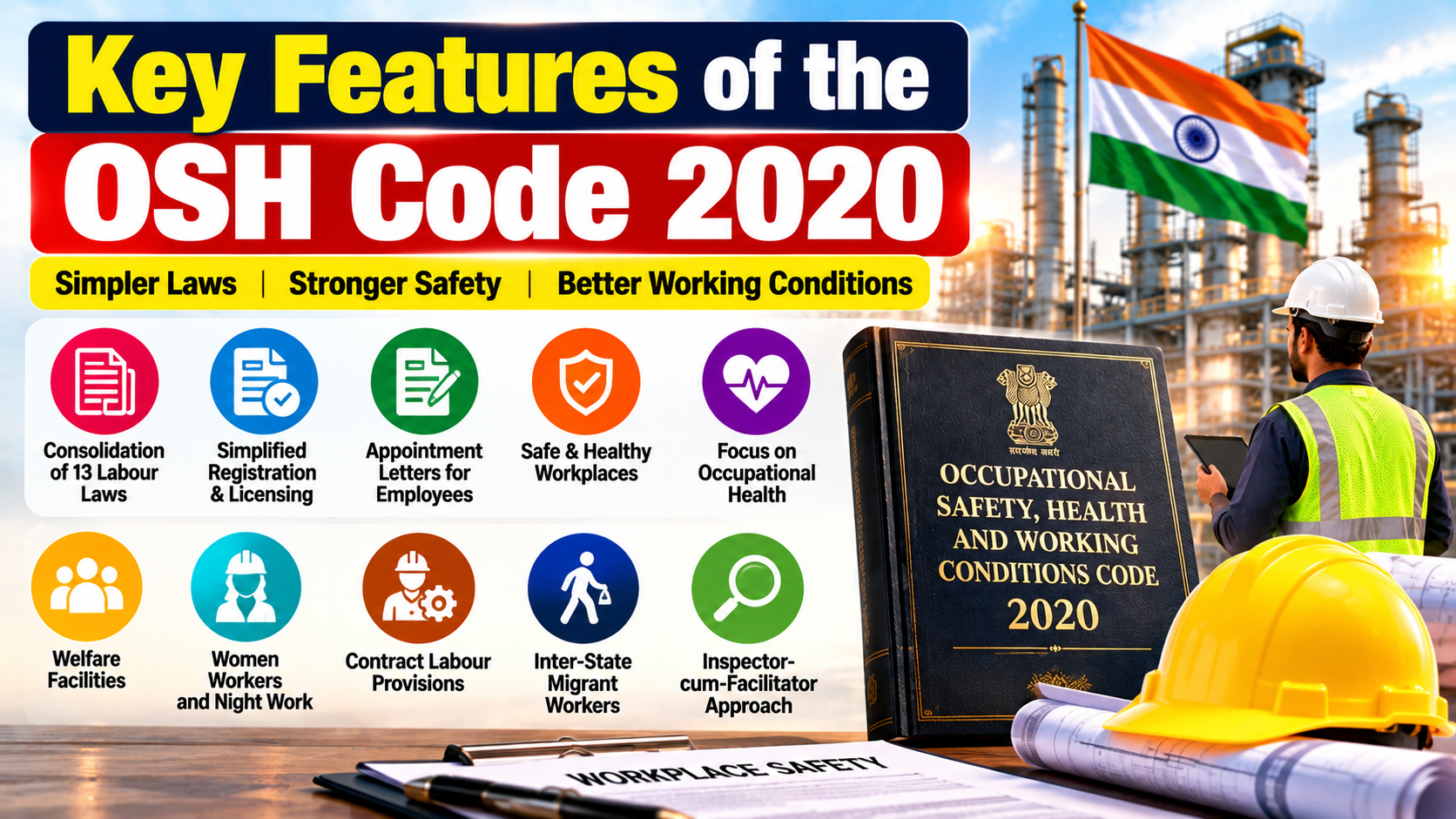
Key Features of the OSH Code 2020
1. Consolidation of 13 Labour Laws
Instead of having multiple Central laws dealing with different aspects of occupational safety and working conditions, the OSH Code brings them together under one principal legislation.
This can make the overall framework easier for employers and professionals to navigate.
2. Simplified Registration
The new framework introduces electronic registration mechanisms.
Under the 2026 Central Rules, establishments covered by the rules can apply electronically through the Shram Suvidha Portal or designated portal using the prescribed form.
The 2026 Central Rules also provide detailed procedures and forms for registration and related compliance.
3. Appointment Letters
The OSH Code provides for an appointment letter to be issued to employees in the prescribed form and manner.
This supports greater formalisation and transparency in employment relationships.
The Government has highlighted appointment letters as one of the worker-focused features of the Labour Code reforms.
4. Safe and Healthy Working Conditions
Workplace safety is at the centre of the OSH Code.
The employer has duties relating to maintaining a working environment that is safe and without risk to employees' health, subject to the standards and requirements established by the Code and applicable rules.
This means safety should be incorporated into normal business operations rather than treated as a document created only for an inspection.
5. Occupational Health
The new framework gives greater emphasis to occupational health.
Government information highlights annual health check-ups in prescribed cases as one of the worker-protection measures associated with the Labour Codes.
For employers, this means occupational health should be considered alongside traditional workplace safety.
Working Hours and Overtime
Working hours and overtime are addressed within the new labour-law framework.
Government explanatory material refers to 8 hours per day and 48 hours per week as the standard framework, with flexibility and overtime subject to prescribed conditions.
Companies should review the detailed applicable rules before designing shift systems or overtime arrangements.
Women Workers Under the OSH Code
The OSH Code allows women to work across establishments and occupations, including at night, subject to consent and prescribed safety, transport and security safeguards.
This is particularly relevant to organisations operating:
- 24-hour production
- Night shifts
- Manufacturing plants
- Hospitals
- Warehouses
- Infrastructure projects
- Service operations
Employers should ensure that applicable safeguards are in place before assigning women to night work.
Contract Labour Under the OSH Code
Contract labour is specifically addressed in the OSH Code.
This is important for industries such as:
- Construction
- Manufacturing
- Infrastructure
- Oil and gas
- Warehousing
- Facility management
The Code consolidates the earlier Contract Labour framework and sets out provisions relating to licensing, welfare and responsibilities.
For Safety Officers, this makes contractor safety management an important professional skill.
Inter-State Migrant Workers
Another important area covered by the Code is Inter-State Migrant Workers.
The Government has highlighted provisions relating to:
- Improved coverage
- Working conditions
- Portability of benefits
- Annual lump-sum travel allowance in applicable cases
The definition has also been expanded to cover certain workers who migrate independently as well as workers engaged through contractors. Press Information Bureau
This is particularly important for industries that rely heavily on migrant labour.
Inspector-cum-Facilitator
The OSH Code introduces the role of the Inspector-cum-Facilitator.
The Government has described the approach as promoting more transparent and technology-based inspection while facilitating compliance. Press Information Bureau
For employers, this reinforces an important principle:
Workplace compliance should be continuous, not something prepared only when an inspection takes place.
Companies should be able to demonstrate that their safety management system actually operates through records, inspections, risk assessments, training and corrective actions.
Safety and Welfare Facilities
The OSH Code contains provisions relating to occupational safety, health and welfare facilities.
Depending on the establishment and applicable requirements, employers may need to consider areas such as:
- Drinking water
- Sanitation
- Washing facilities
- Canteens
- First-aid
- Rest facilities
- Welfare arrangements
- Safety equipment
- Health-related arrangements
The exact requirement depends on the applicable provisions and rules.