
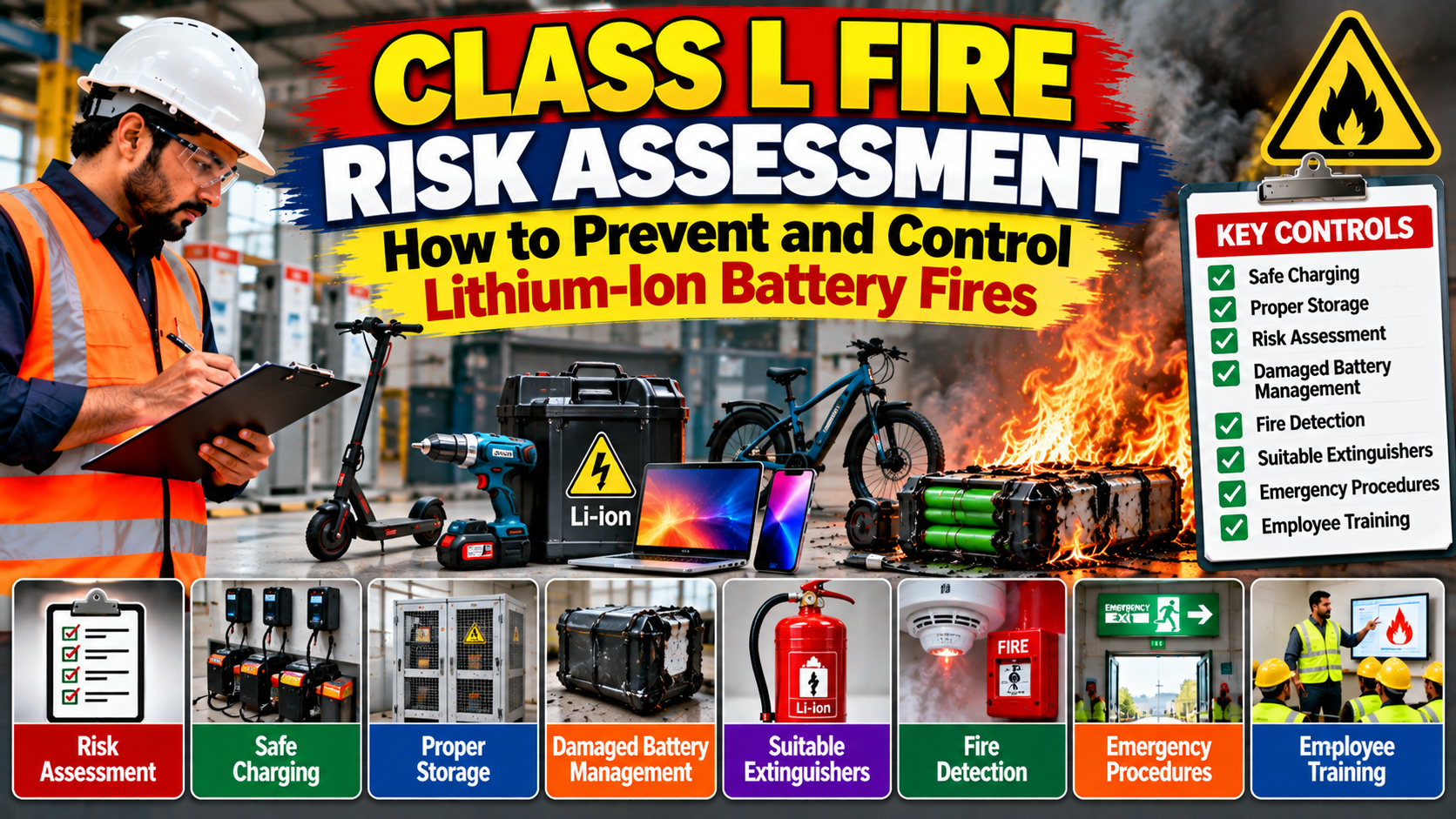
Class L Fire Risk Assessment: How to Prevent and Control Lithium-Ion Battery Fires
Lithium-ion batteries are now a part of modern workplaces and everyday life. They are used in phones, laptops, power tools, e-bikes, e-scooters electric vehicles, battery packs and energy-storage systems.
However damaged, defective or improperly charged lithium-ion batteries can create a fire risk. The BS ISO 3941:2026 classification of fires introduces Class L for fires involving lithium-ion batteries highlighting the importance of recognising this fire risk.
For Safety Officers, Fire Wardens and HSE professionals the key question is not "What is Class L? but also:
How can a workplace identify, prevent and control Class L fire risks?
What Makes Lithium-Ion Battery Fires Different?
Lithium-ion batteries store an amount of energy in a relatively small space.
When a battery becomes unstable it can undergo runaway. During this process the battery temperature can rise rapidly potentially resulting in fire, smoke, gas release and propagation to cells.
This makes lithium-ion battery incidents from many conventional workplace fire scenarios.
BSI identifies lithium-ion battery fires as an increasing concern. Notes the growing need for appropriate fire-suppression products and good practice.
Common Class L Fire Hazards in the Workplace
A workplace may have Class L risks in different locations.
1. Battery Charging Areas
Charging batteries without controls can increase the risk of overheating and fire.
Examples include:
- Charging power-tool batteries
- Charging e-bikes
- Charging e-scooters
- Charging battery packs
- Charging electric vehicles
2. Damaged Batteries
A battery that has been dropped, crushed, punctured, swollen or otherwise damaged may present an increased risk.
Damaged batteries should be. Managed according to an appropriate workplace procedure.
3. Incorrect Chargers
Using a charger or poor-quality charging equipment can create additional risk.
Employees should use chargers and equipment recommended by the manufacturer.
4. Battery Modification
Unauthorised modification, repair or replacement of battery components can introduce hazards.
5. Poor Storage
Large quantities of batteries stored together can increase the consequences of a battery incident.
Storage arrangements should therefore form part of the workplace fire risk assessment.
How to Carry Out a Class L Fire Risk Assessment
A Class L risk assessment should follow the principles of workplace fire-risk assessment while giving specific attention to lithium-ion battery hazards.
Step 1: Identify Lithium-Ion Batteries
First identify where lithium-ion batteries are present.
Look at:
- Offices
- Workshops
- Warehouses
- Maintenance areas
- Charging stations
- Vehicle parking areas
- E-bike/e-scooter storage areas
- Tool rooms
- Battery stores
- Energy-storage areas
Step 2: Identify Possible Sources of Failure
Ask:
- Are batteries being charged?
- Are damaged batteries present?
- Are batteries exposed to heat?
- Are correct chargers being used?
- Are batteries being modified?
- Are batteries stored near combustible materials?
- Are employees carrying out repairs?
- Are charging areas adequately controlled?
Step 3: Identify Who Could Be Harmed
Consider:
- Employees
- Contractors
- Visitors
- Security personnel
- Maintenance workers
- Fire Wardens
- Emergency responders
- People working near battery-storage areas
Particular attention should be given to people who may be sleeping or working close to battery charging or storage areas.
Step 4: Control the Risk
The hierarchy of controls can be applied to lithium-ion battery risks.
Eliminate
Where possible eliminate battery charging or storage activities.
Substitute
Use safer. Battery systems where reasonably practicable.
Engineering Controls
Consider:
- charging locations
- Fire detection
- Ventilation where appropriate
- Separation of battery-storage areas
- Suitable battery cabinets or storage arrangements
- Protection from physical damage
Administrative Controls
Develop procedures for:
- Charging
- Storage
- Inspection
- Damaged batteries
- Battery disposal
- Emergency response
- Employee training
Personal Protective Equipment
PPE may be required for battery-handling or maintenance activities but PPE should not be relied upon as the primary control for a lithium-ion battery fire.
Safe Lithium-Ion Battery Charging
A workplace charging procedure should clearly define:
- Approved chargers
- Approved batteries
- Charging locations
- Inspection requirements
- Charging supervision arrangements
- What to do with damaged batteries
- Emergency procedures
Employees should be instructed not to continue using a battery if they observe heat, swelling, smoke, damage or other warning signs.
What Should You Do With a Battery?
A damaged or swollen lithium-ion battery should be treated seriously.
Employees should:
1. Stop using the battery.
2. Do not attempt repair.
3. Follow the organisations damaged-battery procedure.
4. Keep the battery away from storage where the procedure requires isolation.
5. Inform the Safety Officer or competent person.
6. Arrange appropriate disposal through an authorised process.
Do not place a damaged lithium-ion battery into waste unless it has been assessed and made safe according to the applicable procedure.
Fire Extinguishers for Class L Risks
One of the important points for Safety Officers is that there is **no universal "one extinguisher fits every lithium-ion battery fire" rule.
Extinguisher selection should consider:
- Battery type
- Battery size
- Quantity of batteries
- Location
- Fire scenario
- Manufacturer instructions
- standards
- Fire-risk assessment
BSI has published BS EN 3-11:2026 which addresses additional requirements, test methods and marking for extinguishers suitable for small rechargeable lithium-ion battery fires.
Therefore workplaces should select equipment based on the risk rather than simply choosing a conventional extinguisher because it is labelled for electrical equipment.
Class L Emergency Response
If a lithium-ion battery shows signs of runaway or catches fire employees should follow the sites emergency procedure.
The procedure should address:
- Raising the alarm
- Evacuation
- Calling emergency services
- Preventing exposure to smoke
- Restricting access to the area
- Battery-specific emergency arrangements
- Preventing unnecessary employee intervention
Employees should **not attempt firefighting beyond their level of training, competence and the organisations emergency procedures**.
Class L Fire Prevention Checklist
A workplace can use the following checklist as an awareness tool:
☐ Lithium-ion batteries have been identified
☐ Charging locations have been assessed
☐ Approved chargers are being used
☐ Damaged batteries are identified
☐ Swollen batteries are removed from normal use
☐ Battery storage is controlled
☐ Combustible materials are controlled around charging areas
☐ Employees have received awareness training
☐ Emergency procedures are available
☐ Fire detection arrangements have been reviewed
☐ Suitable firefighting equipment has been assessed
☐ Battery disposal arrangements are established
☐ Fire risk assessment is reviewed periodically
Why Safety Officers Need to Understand Class L
The use of lithium-ion batteries is increasing across workplaces.
A Safety Officer may encounter lithium-ion batteries in:
- Construction companies
- Manufacturing industries
- Warehouses
- Offices
- Hotels
- institutions
- Hospitals
- Logistics companies
- Retail businesses
- Electric vehicle facilities
- Renewable-energy installations
Therefore knowledge of Class L fire risks is becoming increasingly relevant to modern HSE and Fire & Safety professionals.
Class L vs Electrical Fire
A common training mistake is to teach:
Class L = Electrical Fire.
This is incorrect.
Class L specifically relates to lithium-ion battery fires under the classification.
Electrical equipment can be involved in types of fire situations but the electrical nature itself does not define Class L.
This distinction is important when updating Fire & Safety training materials.
Key Message for Fire & Safety Professionals
The introduction of Class L should encourage organisations to go beyond simply adding a letter to their fire-classification chart.
The real objective is to understand the risk created by lithium-ion batteries and implement suitable controls.
A good Class L safety programme should include:
Identify → Assess → Prevent → Control → Train → Respond → Review
Lithium-ion batteries have become a part of modern workplaces but their increasing use also introduces new fire-safety challenges.
The introduction of Class L, for lithium-ion battery fires provides a classification update while new standards and work around lithium-ion battery firefighting equipment are helping the industry develop more specific approaches.
For organisations using lithium-ion batteries the priority should be effective fire-risk assessment, charging, proper storage, damaged-battery management, employee training and appropriate emergency arrangements.
For Safety Officers and Fire & Safety professionals understanding Class L is becoming a part of modern workplace fire-safety knowledge.
About Growth Academy
Growth Academy Pvt. Ltd. Provides Fire & Safety and HSE training programmes designed to develop practical workplace safety knowledge and skills for aspiring and working Safety Professionals.