
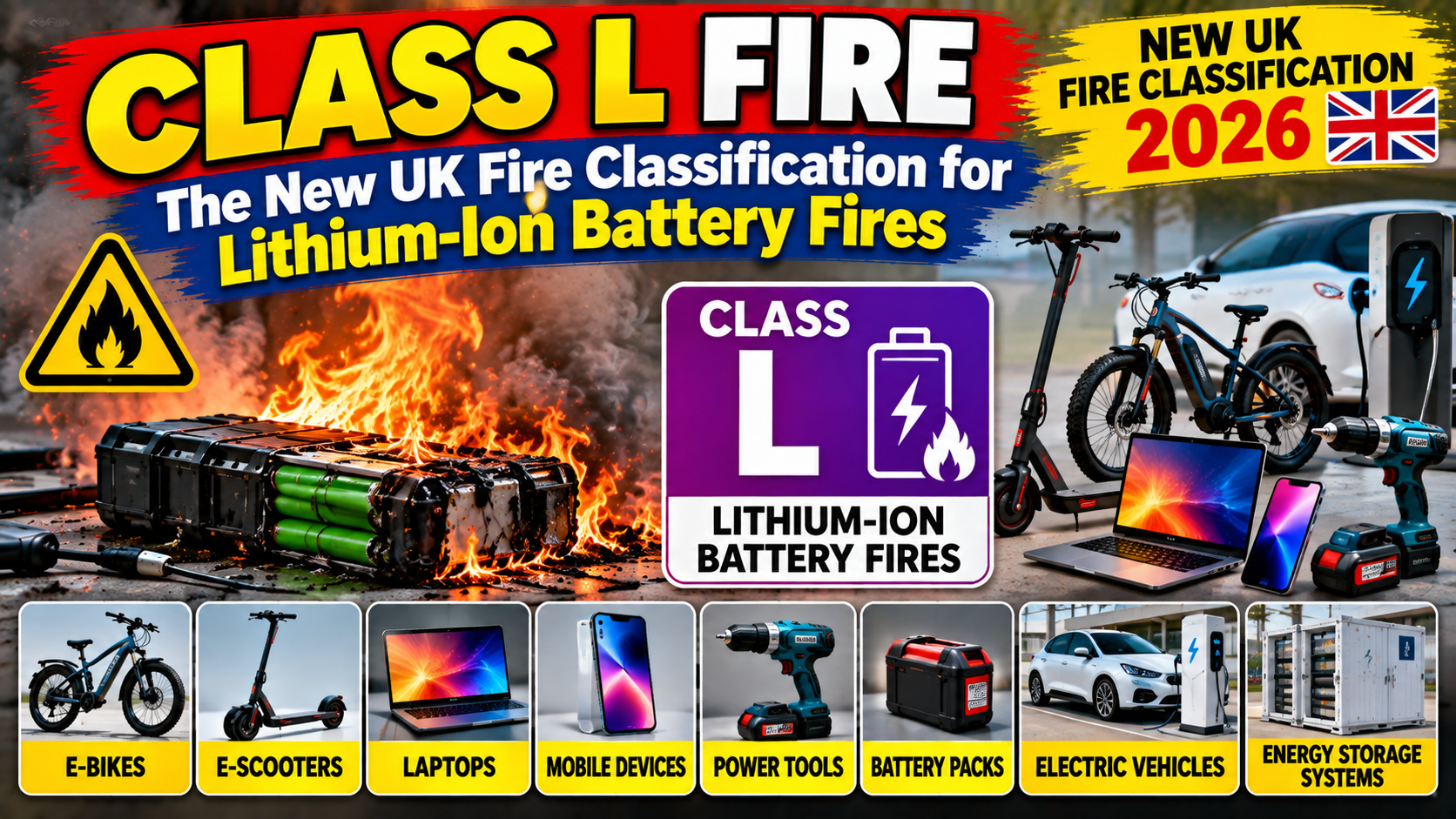
Class L Fire: The New UK Fire Classification for Lithium-Ion Battery Fires
Lithium-ion batteries are now widely used in phones, laptops, power tools, e-bikes, e-scooters electric vehicles and energy-storage systems. As the use of these batteries has increased so has the need for fire-safety guidance.
The 2026 update to BS ISO 3941:2026 – Classification of Fires introduces a Class L specifically for lithium-ion battery fires. The standard was published in January 2026.
This is a development for Fire & Safety professionals, Safety Officers, Fire Wardens and HSE professionals.
What is Class L Fire?
Class L refers to fires involving lithium-ion batteries.
Examples include fires involving:
- Lithium-ion battery packs
- E-bikes and e-scooters
- Laptops and mobile devices
- Power tools
- Portable battery packs
- Electric vehicle batteries
- Battery energy-storage systems
- Rechargeable lithium-ion equipment
The introduction of Class L recognises lithium-ion battery fires as a fire-safety challenge requiring specific consideration.
Why Was Class L Introduced?
Lithium-ion batteries can experience a process known as thermal runaway.
Thermal runaway can occur when a battery cell becomes unstable and rapidly generates heat. This can lead to:
1. Rapid temperature increase
2. Cell failure
3. Release of gases
4. Fire
5. Propagation to cells
6. Re-ignition or continued heating
Lithium-ion battery fires can therefore behave differently from fires.
Common Causes of Lithium-Ion Battery Fires
Some common contributing factors include:
- Physical damage to batteries
- Overcharging
- Defective batteries
- Poor-quality chargers
- charging equipment
- Short circuits
- Excessive heat
- Manufacturing defects
- Battery modification
- Poor storage conditions
- Use of damaged battery packs
Class L Is Not the Same as "Electrical Fire"
One important training point is that Class L should not simply be described as an electrical fire class.
The new classification specifically addresses the nature of the fuel – lithium-ion batteries.
Electrical equipment may be involved in different fire scenarios but the electrical aspect itself is not what defines Class L.
What Should Safety Professionals Do?
Organisations using lithium-ion batteries should review their fire risk assessments. Consider:
1. Battery Storage
Identify where lithium-ion batteries are stored and whether damaged or defective batteries are being separated from stock.
2. Charging Areas
Charging stations should be assessed for:
- Ventilation
- Heat sources
- Charging equipment
- Battery condition
- Fire detection
- Emergency arrangements
3. Damaged Batteries
Damaged, swollen, leaking or overheating batteries should not be treated as waste.
A suitable procedure should be established for isolation, storage and disposal.
4. Emergency Response
Emergency procedures should consider the possibility of:
- Rapid fire development
- Smoke and hazardous gases
- Battery propagation
- Re-ignition
- Difficulty in cooling battery cells
5. Training
Workers should be trained to recognise warning signs such as:
- Swelling
- Unusual heat
- Smoke
- Hissing sounds
- Unusual odour
- Physical damage
- Battery deformation
Class L and Fire Extinguishers
The introduction of Class L does not mean that every conventional fire extinguisher is automatically suitable for lithium-ion battery fires.
Extinguisher selection should be based on the risk, battery type and size manufacturer information, applicable standards and the organisations fire risk assessment.
BSI has also published BS EN 3-11:2026 which introduces requirements and test methods for extinguishers suitable for small rechargeable lithium-ion battery fires.
Therefore Safety Officers should not select an extinguisher simply because it is labelled for equipment. The extinguisher must be appropriate for the lithium-ion battery risk.
Class L – Key Training Point
For Fire & Safety students and HSE professionals:
Class L = Lithium-ion battery fires
It should be treated as a fire-risk category associated with rechargeable lithium-ion batteries.
Why This Update Matters
The introduction of Class L reflects the increasing use of lithium-ion batteries in:
- Electric mobility
- Consumer electronics
- Industrial equipment
- Renewable-energy storage
- Battery energy-storage systems
- Workplace tools and equipment
The UK fire-safety sector is therefore developing additional standards and guidance around lithium-ion battery fire risks.
The introduction of Class L for lithium-ion battery fires is a 2026 development in fire classification.
Fire Wardens, Safety Officers, HSE professionals and Fire & Safety trainers should update their training material and workplace fire-risk assessments to recognise the hazards associated with lithium-ion batteries.
For safety professionals the key message is simple:
Class L = Lithium-ion Battery Fire
Because lithium-ion battery incidents can involve thermal runaway, rapid fire development and re-ignition, prevention, correct storage, safe charging, emergency planning and appropriate firefighting equipment are essential.
About Growth Academy
Growth Academy Pvt. Ltd.provides Fire & Safety and HSE training, including Fire & Safety courses, NEBOSH, IOSH and other occupational safety programmes. Our training focuses on workplace safety modern fire risks and industry-relevant knowledge, for aspiring and working safety professionals.