
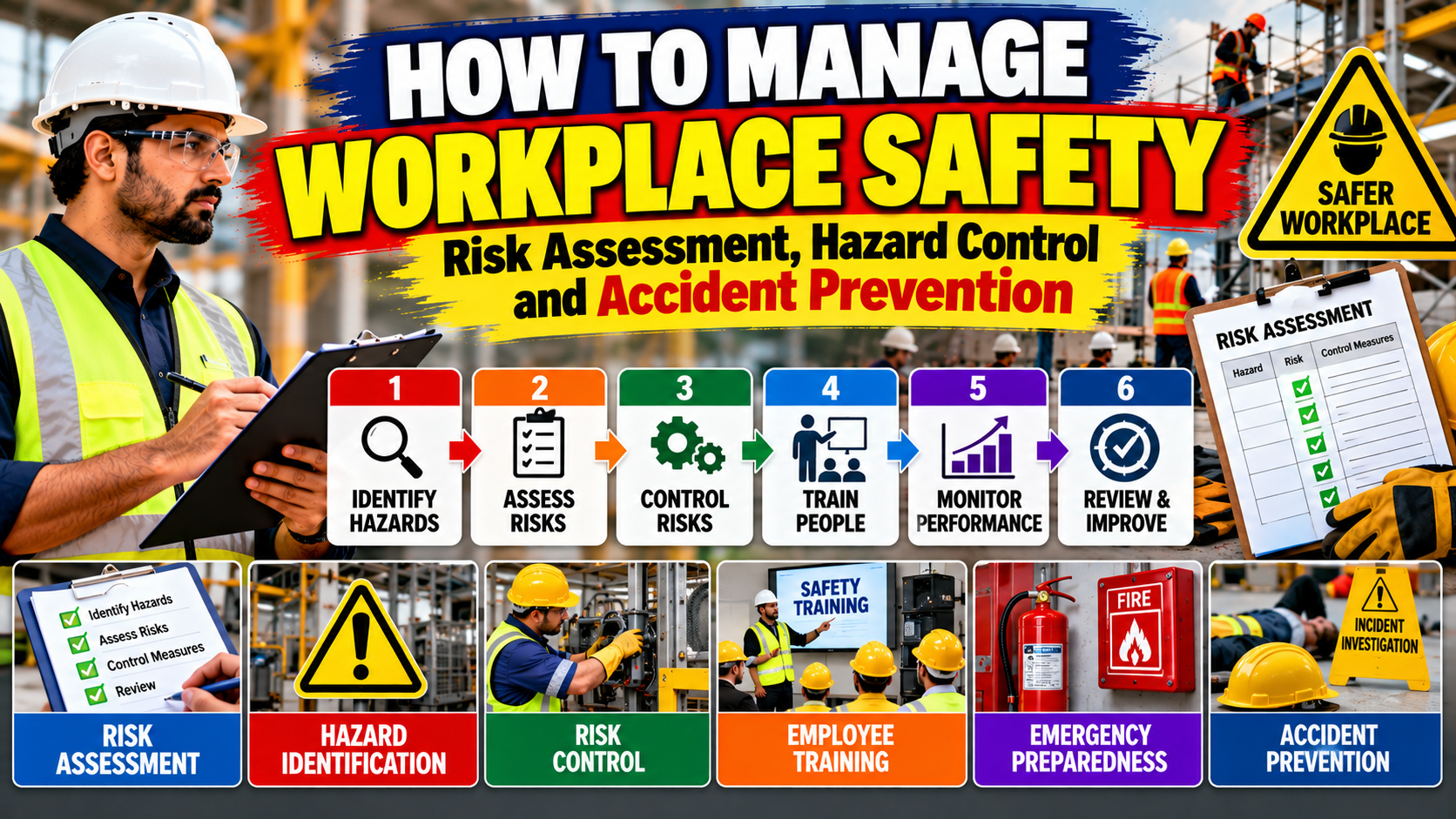
How to Manage Workplace Safety: Risk Assessment, Hazard Control and Accident Prevention
Knowing that workplace safety matters is the first step.
The important question is:
How do we actually manage workplace safety?
A good workplace safety system should give a process for spotting hazards checking risks putting in controls teaching workers watching performance and making the system better.
A simple approach is:
PLAN → IDENTIFY → ASSESS → CONTROL → TRAIN → MONITOR → REVIEW → IMPROVE
This text shows how businesses can use this approach with real workplace examples.
1. Start With Hazard Identification
The first step is to find out what could cause harm.
A hazard may be:
- Machinery
- Electricity
- Chemicals
- Fire
- Noise
- Dust
- Vehicles
- Working at height
- Confined spaces
- Manual handling
- Poor housekeeping
Practical Example: Warehouse
During a warehouse inspection the Safety Officer identifies:
- Forklifts
- Pedestrians
- High-level storage
- Damaged pallets
- Blocked emergency exit
- floor
- Poor lighting
These are hazards.
Simply listing them is not enough.
The next question is:
Who could be harmed and how?
2. Identify Who Could Be Harmed
Consider:
- Employees
- Contractors
- Visitors
- Drivers
- Maintenance workers
- workers
- Young workers
- New employees
Example
A wet floor near a warehouse entrance could affect:
- Workers
- Visitors
- Delivery drivers
The Safety Officer should think of all people who could be exposed.
3. Assess the Risk
Risk assessment asks:
How likely is harm to occur?
How serious could the harm be?
A simple risk model is:
Risk = Likelihood × Severity
For example:
| Hazard | Likelihood | Severity | Risk |
|---|---|---|---|
| Wet floor | 3 | 2 | 6 |
| Forklift collision | 3 | 5 | 15 |
| Fall from roof | 3 | 5 | 15 |
The exact scoring system should fit the companys risk assessment method.
The main point is to find which risks need priority action.
4. Apply the Hierarchy of Controls
Once the risk is clear decide how it can be controlled.
A practical hierarchy is:
- Elimination
- Substitution
- Engineering controls
- Administrative controls
- PPE
The strongest controls usually tackle the hazard near its source.
Practical Example: Chemical Cleaning
Workers use a cleaning chemical.
Weak approach
'Give workers gloves.'
Better approach
Ask:
- Can the chemical be eliminated?
- If not:
- Can a hazardous chemical be substituted?
- If not:
- Can the process be. Controlled?
Then:
- procedure
- Training
- Exposure monitoring where appropriate
- PPE
This is much better than just giving gloves right away.
5. Create Safe Systems of Work
A safe system of work shows how a task should be done safely.
For example a machine-cleaning procedure may include:
- Stop machine
- Isolate energy
- Apply lockout/tagout where required
- Verify isolation
- Clean machine
- Replace guards
- Remove tools
- Inspect
- Restart under controlled conditions
Practical Example: Machine Maintenance
Imagine a worker must clean a conveyor.
Without isolation:
Worker enters danger zone → Conveyor starts → injury
With proper isolation:
Stop → Isolate → Lock → Verify → Work → Inspect → Restore
The difference is the safety system.
6. Use Permit-to-Work for High-Risk Activities
Certain activities may need permits.
Examples include:
- work
- Confined-space entry
- Electrical work
- Excavation
- Certain maintenance activities
Practical Example: Hot Work
A contractor must weld near flammable materials.
A permit-to-work system may require:
- Area inspection
- Removal/control of combustibles
- firefighting equipment
- Fire watch
- Authorisation
- Defined work period
- Post-work inspection
The permit alone is not the control.
The controls listed in the permit are what matter.
7. Train Workers Before They Perform High-Risk Work
Training should match the job.
For example:
Confined-space worker
Needs knowledge of:
- Hazards
- Atmospheric testing
- Ventilation
- Permit
- Communication
- PPE
- Emergency arrangements
- Rescue
Forklift operator
Needs competence, in:
- Vehicle operation
- Load handling
- Stability
- Pedestrian safety
- Pre-use checks
- Site traffic rules
Fire Warden
Needs knowledge of:
- Alarm procedures
- Evacuation
- Assembly points
- Emergency communication
Basic fire safety responsibilities
8. Conduct Toolbox Talks
Toolbox talks are safety chats that focus on one task or danger.
Example: Working at Height Toolbox Talk
Topics:
Fall hazards
Access equipment
Inspection
Guardrails
Fall protection
Dropped objects
Weather conditions
Rescue arrangements
A 10-minute toolbox talk before a high‑risk task can help strengthen the controls.
9. Inspect the Workplace
A risk assessment may say:
"Emergency exit must remain clear."
During an inspection the Safety Officer may discover:
Exit blocked by cartons.
This demonstrates a principle:
A control written in a paper is not always a control that works in real life.
Inspections check if controls are really put in place.
10. Report Near Misses
Near misses should be welcomed.
Example
A worker almost slips because oil has leaked onto a walkway.
No injury occurs.
The correct response is:
Record the near miss
Clean the spill
Find the source
Repair the leak
Review housekeeping
Communicate the lesson
This can stop an injury in the future.
11. Investigate Incidents Properly
An incident investigation should not stop at:
"Worker was careless."
That is often not enough.
Ask:
cause
What happened immediately before the incident?
Underlying cause
Why did the unsafe condition exist?
Root/system cause
Why did the organisations system allow it to happen?
Practical Example: Slip Accident
Worker slips on a floor.
Immediate cause
Oil on floor.
Underlying cause
Machine leaking.
System cause
Maintenance inspection did not identify the leak.
Corrective actions
Repair machine
Improve inspection
Improve spill response
Review maintenance schedule
Train workers
This approach is much stronger than writing:
"Worker should be more careful."
12. Manage Emergency Preparedness
Every workplace should think about emergencies that could happen.
Examples:
Fire
Explosion
Chemical spill
Gas leak
emergency
Confined‑space incident
Electrical incident
Structural failure
Emergency plans should answer:
Who raises the alarm?
Who calls emergency services?
Who evacuates?
Where is the assembly point?
Who accounts for workers?
Who provides aid?
Who communicates with emergency responders?
13. Conduct Drills
An emergency plan that has never been tried may not work as expected.
Practical Example: Fire Drill
During a fire drill management discovers:
One emergency exit is locked
Some employees do not hear the alarm
Visitors are not accounted for
Assembly point is poorly marked
This is information.
The drill has identified weaknesses before a real fire occurs.
14. Manage PPE Properly
PPE management should include:
Selection
Correct size
Compatibility
Training
Inspection
Cleaning
Replacement
Storage
Practical Example
A worker is given safety glasses but they keep fogging.
The worker takes them off while working.
The problem is not just "worker non‑compliance."
The organisation should ask:
Is the PPE suitable for the working conditions?
Safety controls must work in the workplace.
15. Manage Contractors
Contractor safety should include:
Selection → Pre‑qualification → Induction → Risk assessment → Permit → Supervision → Review
Example
A contractor arrives to fix a roof.
Before work begins:
Competence checked
Method statement reviewed
Risk assessment reviewed
Access arrangements confirmed
Emergency arrangements confirmed
Work area inspected
Appropriate supervision established
This stops the mistake of letting contractors just start the job.
16. Monitor Corrective Actions
Finding a hazard is part of the job.
Suppose an inspection identifies:
"Fire exit blocked."
The action should not remain:
Status: Open
The Safety Officer should assign:
Action
person
Deadline
Priority
Verification
Then check that the action has really been finished.
17. Review Risk Assessments
Risk assessments should be reviewed when:
Work processes change
New equipment is introduced
New chemicals are used
An incident occurs
A significant, near miss occurs
New information becomes available
Workplace conditions change
Practical Example
A factory puts an automated machine in use.
The old risk assessment may not be enough.
The organisation should review:
Machine guarding
Electrical isolation
Maintenance
Access
Noise
Emergency stop
Training
Interaction with existing equipment
18. Use. Lagging Indicators
Leading indicators
Measure what safety is doing to prevent incidents.
Examples:
Number of inspections
Training completion
Toolbox talks
Near‑miss reports
Risk assessments completed
Corrective actions closed
Lagging indicators
Measure what safety has already happened.
Examples:
Injuries
Lost‑time incidents
Occupational illness
Fires
Property damage
Lost workdays
A mature safety system should monitor both.
19. Practical Case Study: Construction Site
Consider a construction project.
Hazards
Working at height
Excavation
tools
Vehicles
Falling objects
Manual handling
Safety management process
Step 1: Identify hazards.
Step 2: Assess risks.
Step 3: Implement controls.
Step 4: Train workers.
Step 5: Conduct toolbox talks.
Step 6: Inspect scaffolds.
Step 7: Monitor PPE and behaviour.
Step 8: Report near misses.
Step 9: Investigate incidents.
Step 10: Review controls.
This is a functioning safety cycle.
20. Practical Case Study: Warehouse Forklift Risk
Problem
Forklifts and pedestrians share the route.
Potential consequence
Serious collision.
Initial control
Warning signs.
Better controls
pedestrian routes
Barriers
Controlled crossing points
Speed limits
Lighting
Mirrors
Driver competence
Vehicle inspections
Lesson
A warning sign alone may not be enough.
Engineering and physical controls may give protection.
21. Practical Case Study: Confined Space
A worker must enter a tank.
Potential hazards include:
Oxygen deficiency
Toxic gases
atmosphere
Engulfment
Restricted access
Heat
Difficulty escaping
A system may require:
Risk assessment
Permit
Isolation
Atmospheric testing
Ventilation where appropriate
Communication
Competent workers
Standby arrangements
Rescue plan
The critical lesson is:
Never treat confined‑space entry as a normal job.
22. Practical Case Study: Fire Prevention
A warehouse stores materials.
During inspection the safety officer finds:
Materials stored close to electrical panels
Emergency exit blocked
Damaged extension cables
Poor housekeeping
Instead of waiting for a fire the safety officer:
Removes combustible storage
Clears exit
Replaces damaged cables
Improves housekeeping
Conducts fire‑awareness training
Reviews fire risk assessment
This is safety management.
23. Safety Management Is a Cycle
A good system follows:
PLAN
Set goals and identify hazards.
DO
Implement controls.
CHECK
Measure performance.
ACT
Correct. Improve.
Then the cycle starts again.
Practical Workplace Safety Management Checklist
Hazard Management
☐ Hazards identified
☐ Risk assessments completed
☐ High‑risk activities prioritised
☐ Controls implemented
People
☐ Workers trained
☐ Supervisors competent
☐ Contractors controlled
☐ Employees consulted
Workplace
☐ Inspections completed
☐ Housekeeping controlled
☐ Equipment inspected
☐ Emergency exits clear
Emergency
☐ Emergency plans available
☐ Fire arrangements tested
☐ Drills conducted
☐ First‑aid arrangements available
Improvement
☐ Near misses reported
☐ Incidents investigated
☐ actions tracked
☐ Risk assessments reviewed
☐ Safety performance monitored
The Golden Rule of Workplace Safety
A simple rule can guide every safety officer:
Do not ask only whether a safety document exists.
Ask whether the control actually works.
For example:
Document says: Emergency exit must remain clear.
Inspection shows: Exit blocked.
Therefore: The system is not working.
Similarly:
Training record says: Worker completed PPE training.
Observation shows: Worker does not use PPE.
Therefore: Training alone has not achieved the required behaviour.
This practical approach is the difference between documented safety and effective safety.
Conclusion
Workplace safety management is a process.
It requires:
Hazard Identification
→ Risk Assessment
→ Risk Control
→ Training & Competence
→ Supervision
→ Inspection
→ Incident & Near‑Miss Investigation
→ Review
→ Continuous Improvement
A strong safety officer does not simply collect documents.
A strong safety officer goes into the workplace observes the work identifies what can go wrong talks, to workers checks whether controls are effective and takes action when something is unsafe.
The ultimate objective is not paperwork.
The objective is preventing harm.
About Growth Academy
Growth Academy Pvt. Ltd. Offers training that's very useful for people who want to learn about Fire & Safety and HSE.
Growth Academy Pvt. Ltd. Focuses on real‑world risk assessment.
Growth Academy Pvt. Ltd. Teaches how to control hazard with steps.
Growth Academy Pvt. Ltd. Shows how to do workplace inspections
Growth Academy Pvt. Ltd. Prepares people, for emergencies.
Growth Academy Pvt. Ltd. Helps create Safety Professionals.