
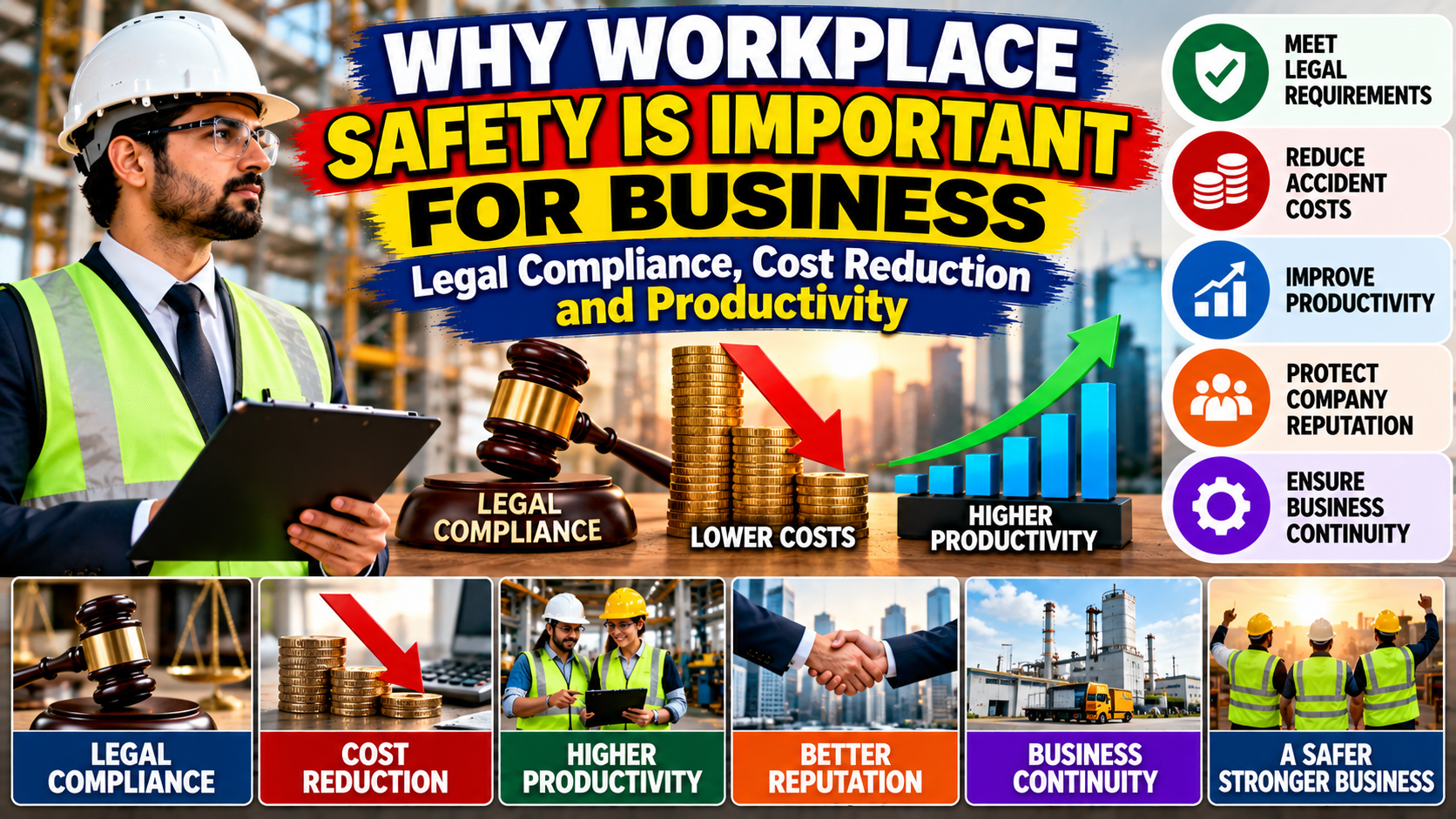
Why Workplace Safety Is Important for Business: Legal Compliance, Cost Reduction and Productivity
Many organisations think about workplace safety from the employees point of view.
Protecting employees is obviously the priority but workplace safety also has a direct impact on the business itself.
A serious accident can result in:
Production stoppage
Equipment damage
costs
Compensation
Investigation
Legal consequences
Employee absence
Recruitment costs
Loss of customers
Damage to reputation
Therefore:
Workplace safety is not a safety responsibility—it is also a business responsibility.
1. Workplace Safety Helps Reduce Business Losses
Every accident has the potential to create losses.
Direct costs
Examples:
Medical treatment
Compensation
Equipment repair
Property damage
Emergency response
costs
Often more difficult to calculate:
Production downtime
Investigation time
Lost working hours
Replacement workers
Retraining
Delayed deliveries
Customer dissatisfaction
Management time
Practical Example: Machine Accident
Suppose a factory machine causes a hand injury.
The obvious cost may be:
treatment + compensation
But the actual business impact may include:
Machine stopped
Production stopped
Incident investigation started
Management involved
Machine inspected
Repairs required
Worker absent
Replacement worker required
Production delayed
Customer delivery affected
A single accident can therefore create many layers of cost.
2. Safety Helps Reduce Downtime
Business operations depend on people and equipment being available.
Unsafe conditions can cause:
Machinery shutdown
Fire
Explosion
Chemical release
damage
Vehicle accidents
Production interruption
Practical Example: Warehouse Fire
A warehouse stores finished products.
A small electrical fault starts a fire.
Even if nobody is injured the business may lose:
Stock
Storage capacity
Electrical equipment
Delivery schedules
Customer confidence
The organisation may need weeks or months to return to operations.
Good fire prevention and emergency planning can significantly reduce exposure.
3. Safety Supports Productivity
There is a misconception:
"Safety slows down production."
designed safety procedures can sometimes create inefficiencies but effective safety management can actually improve operations.
For example:
Better housekeeping reduces searching time.
Good equipment maintenance reduces breakdowns.
Clear procedures reduce mistakes.
Proper training reduces rework.
Good workplace layout improves movement.
Hazard control reduces interruptions.
Example: Warehouse Housekeeping
Imagine a warehouse where materials are randomly placed.
Workers spend 10 minutes searching for tools and materials times each day.
Now the company introduces:
Designated storage
Labels
Marked walkways
Tool locations
Housekeeping inspections
The workplace becomes safer and workers spend time searching.
Safety improvement has also become an efficiency improvement.
4. Safety Supports Legal Compliance
Depending on the country, industry and type of work organisations may have requirements relating to:
Risk assessment
Worker training
PPE
Fire safety
Machinery
Chemicals
Electrical safety
Emergency preparedness
Accident reporting
Occupational health
Failure to meet applicable requirements can expose organisations to enforcement, penalties and legal claims.
Safety management therefore helps organisations demonstrate that risks are being actively managed.
5. Example: Risk Assessment Failure
Imagine a construction company where workers are regularly working at height.
The company has no documented risk assessment and workers use whatever access equipment is available.
An accident occurs.
During the investigation management is asked:
What was the hazard?
Was the risk assessed?
What controls were required?
Was the worker trained?
Was the equipment inspected?
Was supervision provided?
If the company cannot demonstrate a system the consequences may be much more serious.
This is why risk assessment should be a working management tool, not a document prepared for an audit.
6. Safety Protects the Companys Reputation
Reputation takes years to build and can be damaged quickly.
Customers may ask:
Does the company protect workers?
Does it have safety procedures?
Does it train employees?
Does it manage contractors?
Does it investigate incidents?
A serious accident can attract attention from:
Customers
Employees
Regulators
Media
Business partners
Investors
A strong safety culture supports responsible business reputation.
7. Safety Improves Employee Retention
Employees are more likely to stay with organisations where they feel:
Safe
Supported
Properly trained
Properly equipped
Practical Example
Two companies offer similar salaries.
Company A:
housekeeping
No PPE
Unsafe equipment
No proper training
Company B:
Good PPE
Proper induction
Regular training
Clean workplace
Responsive management
Which company is likely to build greater employee confidence?
The answer is obvious.
Safety can therefore contribute to employee retention.
8. Safety Reduces Absenteeism
Workplace injuries and occupational illnesses can result in employees being absent.
Examples:
Back injury
Hand injury
Hearing problems
Respiratory illness
Stress
Musculoskeletal disorders
Practical Example
A warehouse worker repeatedly lifts 30 kg boxes manually.
After months the worker develops back pain.
A better system might have introduced:
Mechanical handling equipment
Team lifting
Reduced load size
Better storage height
Manual-handling training
Preventing the exposure is better than treating the injury afterward.
9. Safety Protects Equipment and Property
Safety management also protects assets.
Examples:
Machinery
Buildings
Vehicles
Electrical equipment
materials
Finished products
Computers
Storage systems
Practical Example
A forklift repeatedly hits warehouse racking.
Management keeps repairing the rack.
A stronger approach asks:
Why is the forklift hitting the rack?
Possible causes:
Poor traffic layout
pedestrian separation
Poor visibility
Inexperienced driver
Excessive speed
Narrow aisles
Solving the underlying cause can prevent repeated damage.
10. Safety Improves Business Continuity
Business continuity means being able to continue operations after an event.
Safety management supports continuity through:
Emergency plans
Fire prevention
Equipment maintenance
Emergency response
Backup arrangements
Evacuation planning
Incident preparedness
Practical Case Study: Chemical Spill
A chemical storage area experiences a leak.
Without an emergency plan:
Leak → Confusion → Workers exposed → Delayed response → contamination
With proper planning:
Leak → Alarm → Area isolated → Trained response → Emergency services → Controlled incident
Preparation changes the outcome.
11. Safety Improves Contractor Management
Contractors can introduce risks.
For example:
A maintenance contractor arrives to perform work.
Without controls:
work + combustible material → Fire risk
With proper controls:
Contractor induction
Permit-to-work
Area inspection
Removal of combustibles
Fire extinguisher
Fire watch
Post-work monitoring
The risk is significantly better controlled.
12. Safety Improves Customer Confidence
Many customers now expect suppliers and contractors to demonstrate safety management.
They may ask for:
Safety policies
Training records
Risk assessments
Inspection reports
Incident statistics
Competency certificates
A safety system can therefore help support business relationships.
13. Safety Can Improve Quality
Safety and quality often overlap.
Consider a manufacturing process.
Poor housekeeping can cause:
Trips
products
Contamination
Delays
Equipment problems
Good housekeeping can improve both safety and product quality.
Similarly standard operating procedures can reduce:
actions
Production errors
Quality defects
14. Safety Encourages Better Management
When management regularly reviews safety performance it is forced to ask:
What is going wrong?
Why are incidents occurring?
Which controls are failing?
Where are resources needed?
Are workers competent?
Are procedures effective?
These are management questions—not only safety questions.
15. Safety Investment vs Accident Cost
A company may hesitate to spend ₹2 lakh on a safety improvement.
But if that improvement prevents:
One serious injury
One machine fire
One major production shutdown
the investment may be justified.
Example
Company investment:
₹2,00,000
loss from a serious incident:
Medical + compensation + equipment + downtime + lost production + reputation
The potential loss may be many times higher.
This is why safety should be viewed as risk management, not an expense.
16. Example: Forklift Safety
A warehouse has 10 forklifts.
Management notices frequent near misses between forklifts and pedestrians.
Possible solutions:
pedestrian routes
Physical barriers
Speed limits
Warning signs
Mirrors
Lighting
Forklift inspection
Driver training
Pedestrian awareness
Traffic management plan
The investment may appear expensive.
One serious collision could cost considerably more.
17. Safety KPIs, for Management
Management can monitor:
Leading indicators
Safety inspections completed
Training completed
Toolbox talks conducted
Near misses reported
Risk assessments reviewed
Corrective actions closed
Safety observations
Lagging indicators
Lost-time injuries
Medical-treatment cases
Lost workdays
Property damage
Fires
Occupational illnesses
A good safety programme should not wait for injuries before measuring performance.
18. The Business Safety Equation
A useful way to think about workplace safety is:
Good Safety
↓
Fewer Incidents
↓
Less Downtime
↓
Lower Costs
↓
Better Productivity
↓
Employee Confidence
↓
Stronger Business
This does not mean every safety investment automatically produces a financial return but effective risk management can prevent significant losses and improve operational resilience.
Business Safety Checklist
Management should ask:
Are risks identified?
Are risk assessments current?
Are workers competent?
Are contractors controlled?
Are emergency arrangements tested?
Are incidents investigated?
Are actions completed?
Are safety KPIs reviewed?
Is equipment maintained?
Is the safety budget adequate?
Are employees involved?
Workplace safety is not a cost centre that exists separately from the business.
It supports:
Legal compliance
Employee protection
Productivity
Business continuity
Asset protection
Employee retention
Customer confidence
Reputation
The successful organizations know that stopping problems from happening is usually better than dealing with the results.
A safe business is a managed business.
About Growth Academy
Growth Academy Pvt. Ltd. Offers Fire & Safety and HSE training that is created to build real-world safety knowledge skills, for managing risks at work and experts in safety.