
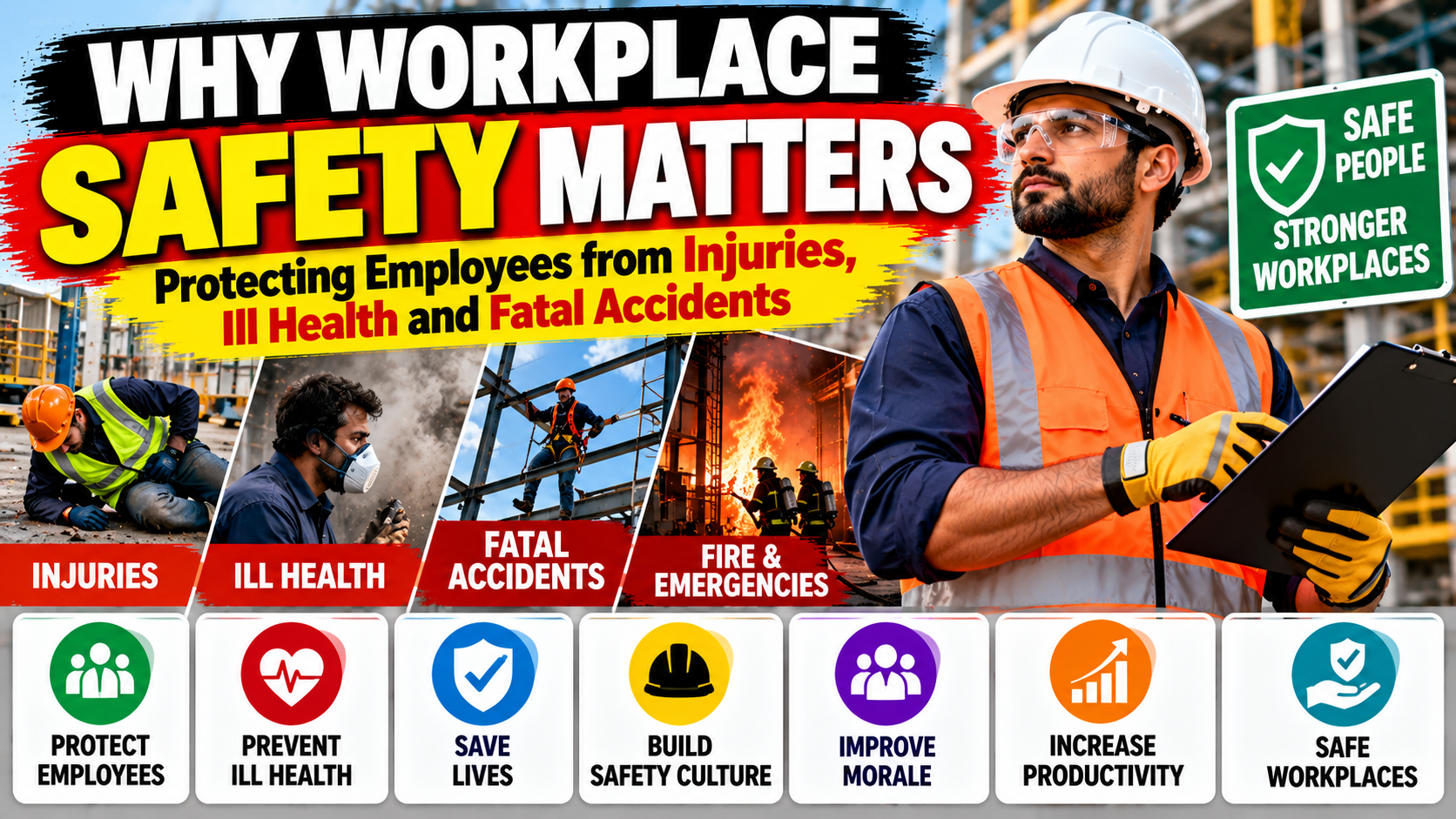
Why Workplace Safety Matters: Protecting Employees from Injuries, Ill Health and Fatal Accidents
Every workplace contains hazards.
A construction site may hold dangers such as working at height, excavation, electrical equipment and moving vehicles. A factory may have machinery, chemicals, noise, heat and manual-handling hazards. A warehouse may contain forklifts, falling materials and vehicle-pedestrian interaction.
Even an office can carry risks such as slips and trips electrical hazards, fire, poor workstation design and work‑related stress.
This is why Workplace Safety is far more than wearing a safety helmet or placing warning signs.
Workplace Safety means identifying hazards assessing risks putting in controls and ensuring people are capable to perform their work safely.
The main objective is simple:
Every worker should be able to finish their work and return home safely.
What Is Workplace Safety?
Workplace Safety is the control of hazards that could bring injury, illness, property damage or other loss.
Workplace Safety includes areas such as:
- Fire safety
- Electrical safety
- Machinery safety
- Working at height
- Confined space safety
- Chemical safety
- Manual handling
- PPE
- Occupational health
- Emergency preparedness
- Vehicle safety
- Contractor safety
- Workplace ergonomics
- Mental health and wellbeing
Workplace Safety is therefore not the duty of the Safety Officer.
Workplace Safety involves:
- Management
- Safety Professionals
- Supervisors
- Workers
- Contractors
1. Protect Employees from Injuries
The reason to manage Workplace Safety is to avoid injuries.
Workers may face hazards each day.
Common Workplace Safety injuries include:
- Cuts
- Burns
- Fractures
- Sprains
- Crush injuries
- Eye injuries
- Back injuries
- Electric shock
- Falls
- Chemical exposure
Practical Example: Grinding Work
Imagine a worker using an angle grinder without controls.
The worker is exposed to:
Flying particles
Sparks
Noise
Disc failure
Hand injury
Fire risk
If the worker does not wear eye and face protection a small metal particle can cause a serious eye injury.
How can the risk be controlled?
The organisation should consider:
Correct machine and disc selection
Guarding
Pre‑use inspection
Safe operating procedure
Suitable eye/face protection
Hearing protection
Training
Supervision
Control of combustible materials
The key lesson is:
PPE alone is not the complete solution.
The hazard should be controlled at source wherever practicable.
2. Prevent Fatal Accidents
Some Workplace Safety hazards can cause death.
Examples include:
- Working at height
- Confined spaces
- work
- Excavation
- Heavy lifting
- Moving vehicles
- Machinery
- Fire and explosion
- Hazardous chemicals
Practical Example: Working at Height
A maintenance worker needs to replace a light fitting at about 5 metres.
The easiest option might appear to be:
"Bring a ladder and finish the job."
The Safety Officer should ask:
- Is work at height necessary?
- Can the work be completed from ground level?
- Is suitable access equipment available?
- Has the equipment been inspected?
- Is the worker competent?
- What happens if the worker falls?
- Is rescue/emergency planning required?
A safer solution may use access equipment and proper planning instead of simply sending a worker up a ladder.
The principle is:
Plan the job before starting the job.
3. Prevent Occupational Ill Health
Not every Workplace Safety hazard causes injury.
Some hazards cause health problems gradually.
Examples include:
- Noise
- Long‑term exposure can bring hearing damage.
- Dust
- Certain dusts can bring problems.
- Chemicals
- Repeated exposure may bring skin, respiratory or other health effects.
- Vibration
- Long‑term exposure, to hand‑arm vibration can bring health problems.
- Manual Handling
- Repeated lifting can bring musculoskeletal disorders.
- Work‑Related Stress
- Poor workload, work organisation or other psychosocial factors can bring mental health issues.
Example: Factory Noise
Consider a manufacturing plant where workers operate near noisy machinery for many hours each day.
A weak safety approach would be:
Give everyone earplugs.
A stronger approach asks:
- Can the noise be reduced at source?
- Can quieter machinery be used?
- Can machinery be enclosed?
- Can exposure time be reduced?
- Is hearing protection required?
- Should hearing health surveillance be considered?
- Are workers trained?
This shows a principle:
Good Workplace Safety management controls the hazard instead of simply giving workers PPE.
4. Protect Mental Health and Wellbeing
Modern workplace safety covers more than physical dangers.
Employees may also experience:
workload
Long working hours
Poor communication
Workplace conflict
Lack of support
Bullying
Poor work organisation
Work-related stress
Practical Example: Excessive Workload
Suppose a Safety Officer is responsible for:
5 factories
1,000 workers
Daily inspections
Incident investigations
Training
Documentation
but receives no assistant and faces unrealistic deadlines.
The organisation may have a Safety Officer on paper. The safety-management system itself may lack resources.
An resourced safety-management system can lead to:
Missed inspections
Delayed corrective actions
Poor incident investigation
Stress
Reduced effectiveness
Therefore management must examine whether safety arrangements are truly sufficient and effective.
5. Build a Positive Safety Culture
A company can have hundreds of safety procedures yet still perform poorly on safety.
Why?
Because safety culture is important.
A positive safety culture means employees believe:
"Safety is genuinely important here."
Workers should feel saying:
"This job is not safe."
without fear of punishment.
Example
A worker sees that an emergency exit is blocked by stored materials.
In a safety culture:
"Don't worry. We'll move it later."
In a safety culture:
Worker reports the problem → Supervisor acts → Materials are removed → Corrective action is recorded.
The difference is not the safety policy.
The difference is behaviour and management commitment.
6. Encourage Near-Miss Reporting
A miss is an event that could have caused harm but did not.
Example
A worker walks through a warehouse.
A box falls from a rack. Misses the worker by one metre.
Nobody is injured.
Should the company ignore it?
No.
The correct questions are:
Why did the box fall?
Was the rack overloaded?
Was the material stored correctly?
Was the rack damaged?
Was the inspection system effective?
Could someone have been seriously injured?
A near miss gives the organisation a chance to fix the problem before someone is hurt.
7. Involve Employees in Safety
Employees are often the people who understand the work best.
A Safety Officer may prepare a risk assessment. The operator may know:
"This machine jams every afternoon."
"When we clean this machine this guard has to be removed."
That information is extremely valuable.
Employees should therefore participate in:
Risk assessments
Toolbox talks
Safety meetings
Inspections
Incident investigations
Safety committees
Hazard reporting
8. Provide Effective Safety Training
Training should develop competence, not provide certificates.
For example a worker trained in working at height should understand:
Hazards
Equipment selection
Inspection
Safe use
Fall prevention
Emergency procedures
Practical Example
Giving a worker a 20-minute PowerPoint presentation, on scaffolding does not necessarily make them competent to erect scaffolding.
Training must match:
The. The hazard + the workers responsibility.
9. Make Supervisors Part of Safety Management
A Safety Officer cannot be present everywhere.
Supervision is therefore very important.
A supervisor should monitor:
Work practices
PPE
Housekeeping
Equipment condition
procedures
Worker behaviour
Unsafe conditions
Practical Example
A Safety Officer conducts a morning inspection and finds everyone wearing helmets.
At 3 PM the Safety Officer leaves.
The supervisor later notices workers removing helmets.
This is why safety supervision must continue throughout the work activity.
10. Protect Contractors and Visitors
Safety responsibility extends beyond employees.
A workplace may contain:
Contractors
Subcontractors
Visitors
Delivery drivers
Maintenance workers
workers
Practical Example
A contractor enters a factory to repair electrical equipment.
The contractor does not know:
Emergency exits
Assembly point
Permit requirements
Isolation procedure
A proper induction should happen before work begins.
11. Fire Safety Is Part of Workplace Safety
A workplace fire can result in:
Burns
Smoke inhalation
Fatalities
Property damage
Business interruption
Fire safety should include:
Fire risk assessment
Detection
Alarm systems
Emergency exits
Fire extinguishers
Emergency lighting
Evacuation procedures
Fire drills
Training
12. Practical Case Study: Small Factory Fire
Imagine a factory where cardboard packaging is stored beside an electrical distribution board.
The risk is obvious:
Electrical fault plus combustible material equals a fire.
A good Safety Officer sees the safety hazard while inspecting.
Corrective action
Remove materials
Maintain clearance around electrical equipment
Improve housekeeping
Inspect electrical equipment
Train employees
Review fire-risk assessment
The company prevented an incident before a fire could happen.
13. Safety Is Everyones Responsibility
Management
Provides:
Leadership
Resources
Training
Equipment
Competent personnel
Safety Officer
Manages:
Risk assessments
Inspections
Training
Safety monitoring
Incident investigations
Supervisor
Ensures:
Procedures are followed
Workers are supervised
Unsafe behaviour is corrected
Worker
Must:
Follow safety procedures
Use PPE
Report hazards
Report near misses
Participate in training
14. A Simple Workplace Safety Model
A practical safety system can follow:
IDENTIFY
↓
ASSESS
↓
CONTROL
↓
TRAIN
↓
MONITOR
↓
REVIEW
↓
IMPROVE
This cycle should continue throughout the life of the workplace.
Workplace Safety Checklist
Ask:
Have all significant hazards been identified?
Are risk assessments
Are workers trained?
Are supervisors competent?
Is PPE suitable?
Are emergency arrangements established?
Are near misses reported?
Are inspections conducted?
Are actions closed?
Are employees involved?
Are contractors controlled?
Are incidents investigated?
Workplace safety is fundamentally, about protecting people.
A safe workplace is not created by paperwork
It requires:
Leadership + Competence + Risk Control + Employee Participation + Continuous Safety Improvement
The best safety system prevents accidents before they happen.